
Open-source DistCache Beats Alluxio Commercial: Curvine's Latest MLPerf Results
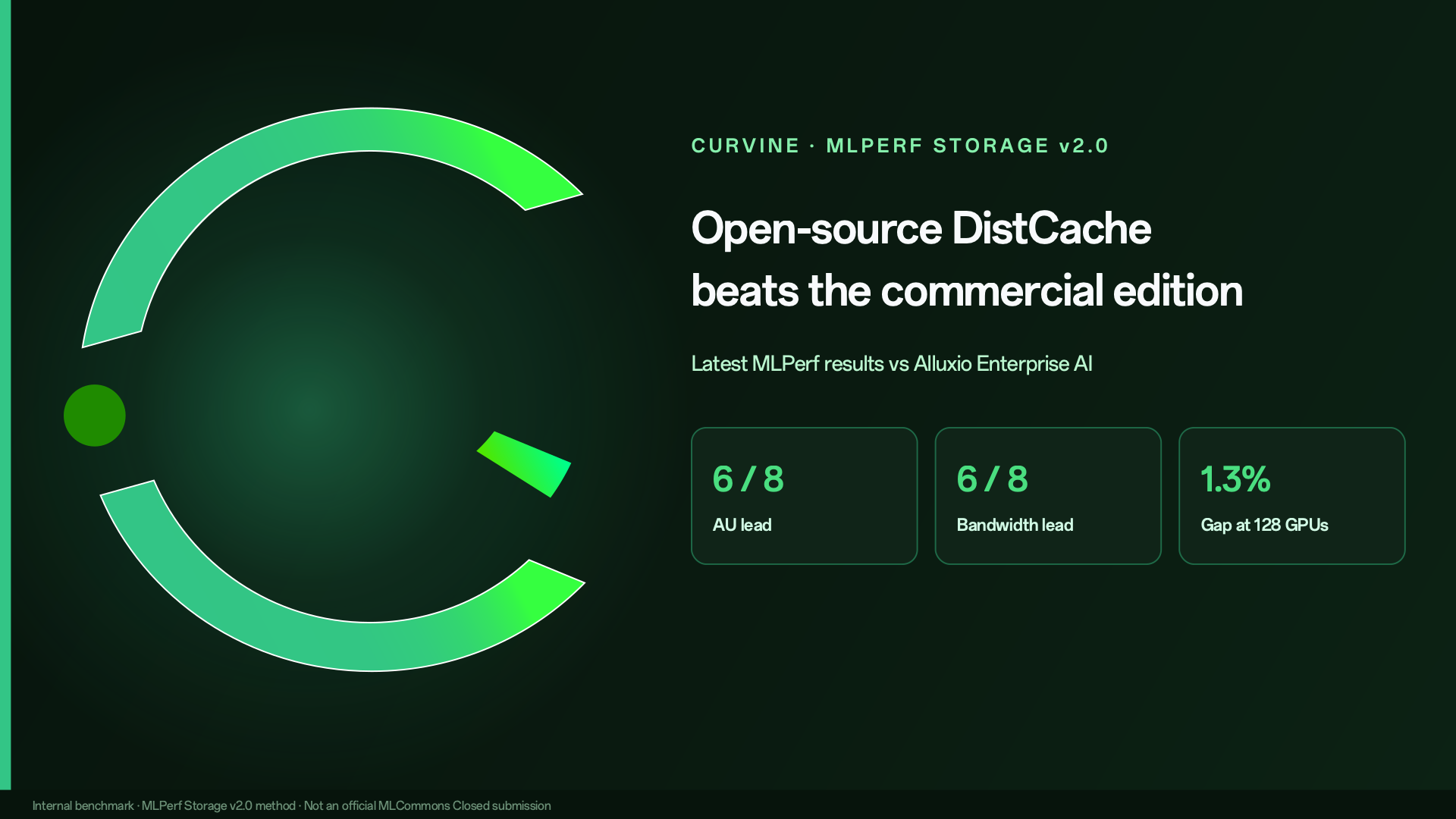
When GPUs wait on data, the cluster is idling. For training storage, the industry now uses the same ruler: MLPerf Storage.
Alluxio submitted official numbers for commercial Alluxio Enterprise AI in the MLCommons Closed division. Curvine is an Apache-2.0 open-source project. We ran an internal comparison with the same MLPerf Storage v2.0 method and the same class of AWS machines. The baseline is not open-source Alluxio. It is the commercial edition they submitted.
Numbers first, then the reading.
Across eight runs, open-source Curvine leads accelerator utilization (AU) in 6 groups, and aggregate read bandwidth in 6 groups with 1 tie. It is ahead on all three U-Net3D lines. CosmoFlow bandwidth is higher on both scales, and the 5-accelerator AU also moves in front. The only bandwidth loss is ResNet-50 at 128 emulated H100s: 23.83 vs 24.14 GiB/s, about 1.3%.
Not every decimal wins. On the same ruler, the open-source implementation is already ahead of the commercial Closed submission on most points. Below we lay out the background, the setup, and the tables.
What MLPerf Storage measures
MLPerf is an AI benchmark suite maintained by MLCommons. The training and inference tracks ask how fast a model computes. The Storage track does not score FLOPS. It asks whether storage can keep accelerators fed.
During training, accelerators pull random samples by batch. If storage is a half-step late, GPUs sit idle. MLPerf Storage answers: how many cards can this storage keep busy enough.
You do not need a rack of real H100s. The harness (DLIO) reads through PyTorch or TensorFlow at the real batch size, replaces "compute one batch" with a sleep() timed from real H100 measurements, and uses an MPI barrier to emulate gradient sync. The data path is real: POSIX, FUSE, into client memory. Only then does a delivery count.
The headline metric is Accelerator Utilization (AU):
AU = emulated compute time / wall-clock time
Higher AU means less time GPUs wait on data. The v2.0 pass lines are:
| Workload | Typical sample | I/O shape | AU bar |
|---|---|---|---|
| ResNet-50 | ~115 KB | Small files, high-concurrency opens; metadata and FUSE heavy | ≥ 90% |
| U-Net3D | ~140 MB | Large sequential reads; ~2.9 GiB/s per accelerator | ≥ 90% |
| CosmoFlow | ~2.8 MB | Random reads, denser sync; tail latency shows up | ≥ 70% |
After the pass line, look at aggregate bandwidth and whether per-accelerator bandwidth drops. These are three different exams. Passing ResNet does not mean you pass U-Net. Passing U-Net does not mean CosmoFlow AU will hold.
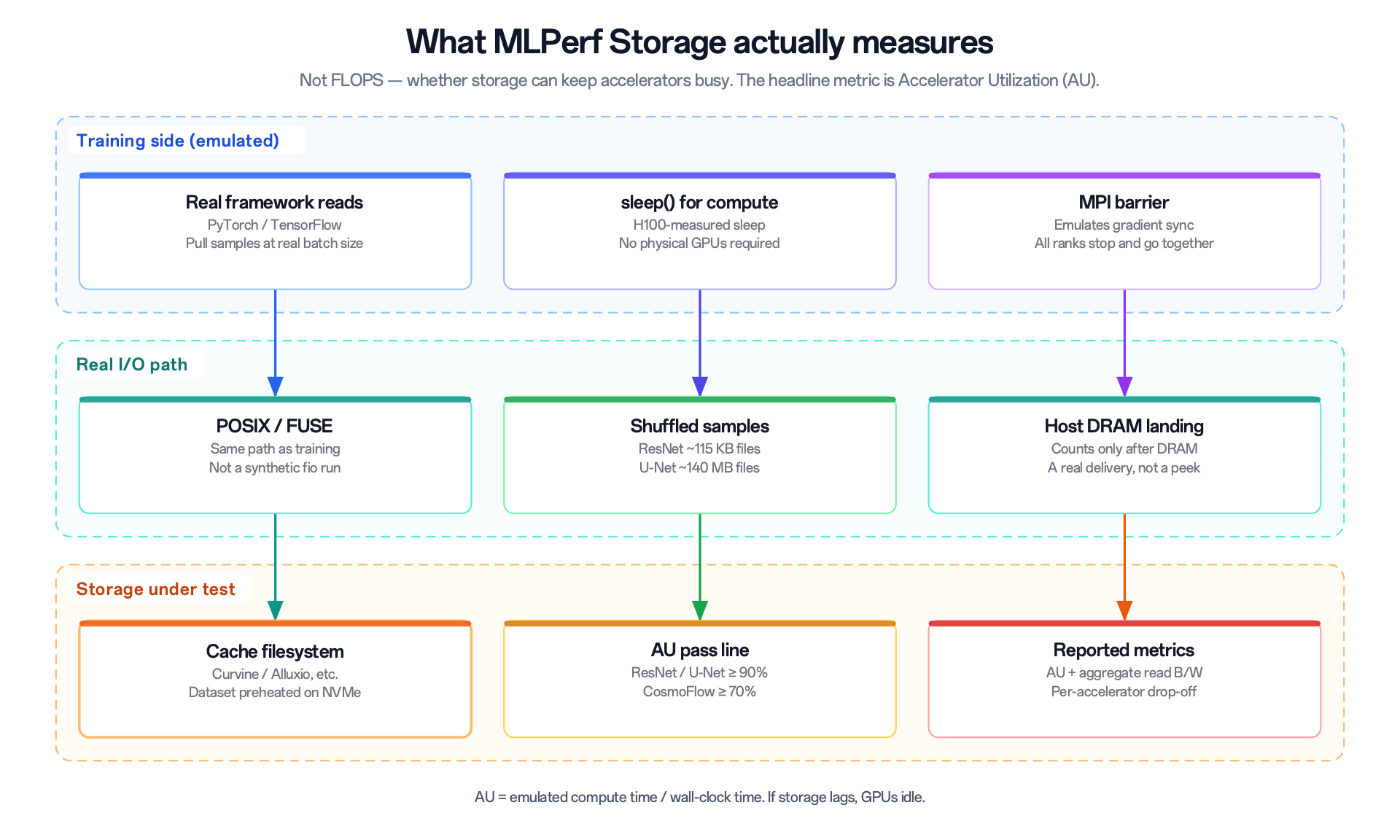
Figure 1: The benchmark is not compute. It is whether storage can keep accelerators busy. The headline metric is AU.
Alluxio's official results live in MLCommons storage_results_v2.0 / closed/Alluxio. Their docs list 24.14 GiB/s for ResNet-50 at 128 accelerators. Curvine has not filed a Closed submission. What follows is an internal comparison, not an official leaderboard. That should be clear up front.
How we measured: same SKUs, same POSIX path
A comparison only holds if the topology matches.
Alluxio's official environment is AWS instances in one AZ: Workers on i3en.12xlarge (48 vCPU / 384 GiB, local NVMe), FUSE clients on c5n.9xlarge (36 vCPU / 96 GiB), POSIX FUSE, dataset fully warmed into cache. Curvine used the same class of machines:
| Role | AWS-equivalent SKU | Count | Hard limits |
|---|---|---|---|
| FUSE client (load gen) | c5n.9xlarge | 1–8 | ≥ 36 cores, 96 GiB isolated |
| Worker (cache tier) | i3en.12xlarge | 2–8 | ≥ 48 cores / 384 GiB, enterprise NVMe |
| Master (metadata) | Shared with a worker | 1 | Separate metadata process |
Accelerators are emulated H100s. Dataset size scales with the run: 500 GB → 1.0 TB → 4.0 TB. Fuse
ratios for ResNet and U-Net match Alluxio's official table (1, 2, 8). CosmoFlow at 8 accelerators differs: Curvine used 2 FUSE + 8 Workers; Alluxio's table is 8 FUSE + 8 Workers. Keep that in mind on that one row.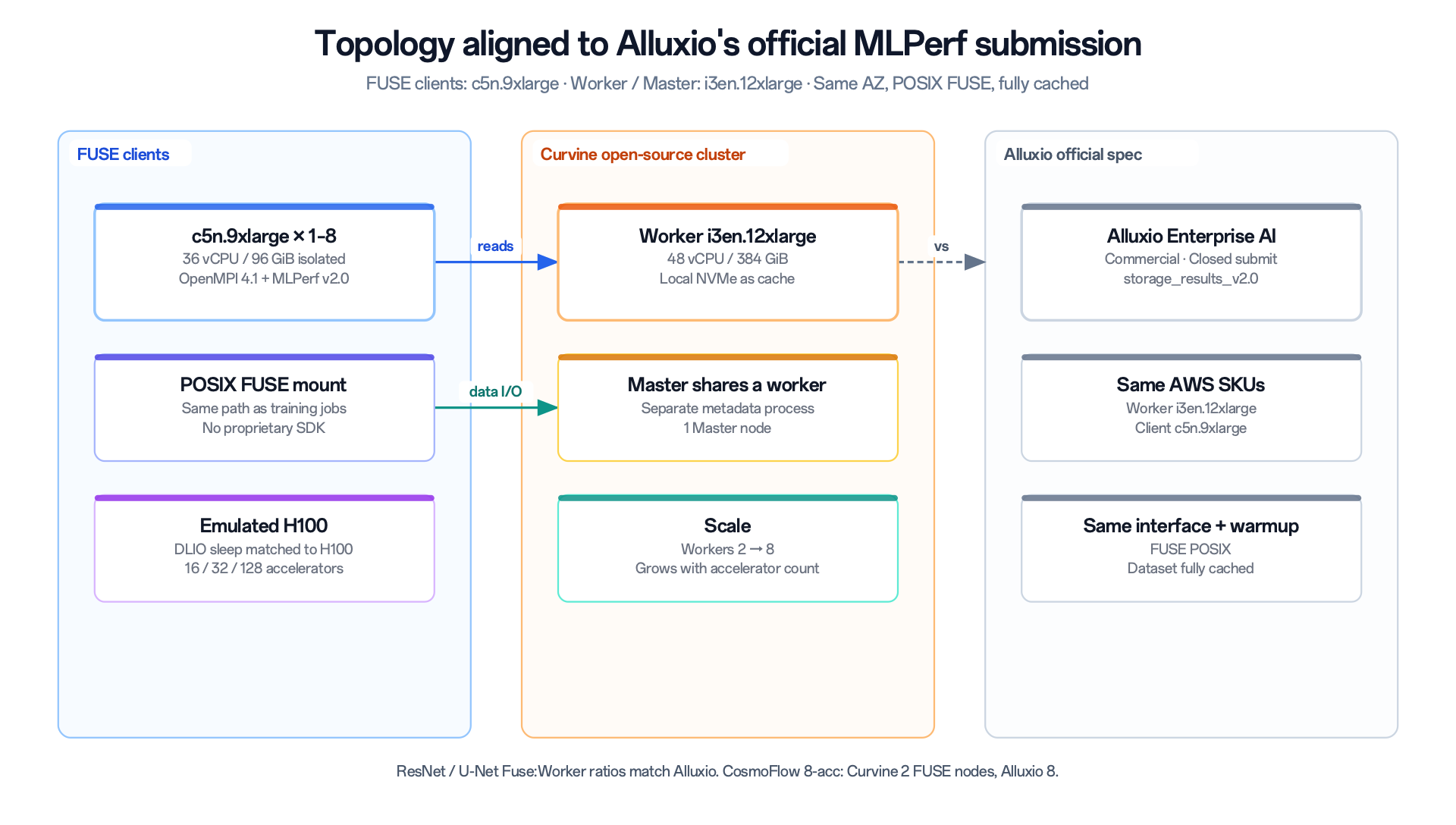
Figure 2: Hardware, interface, and warmup aligned to Alluxio's official submission.
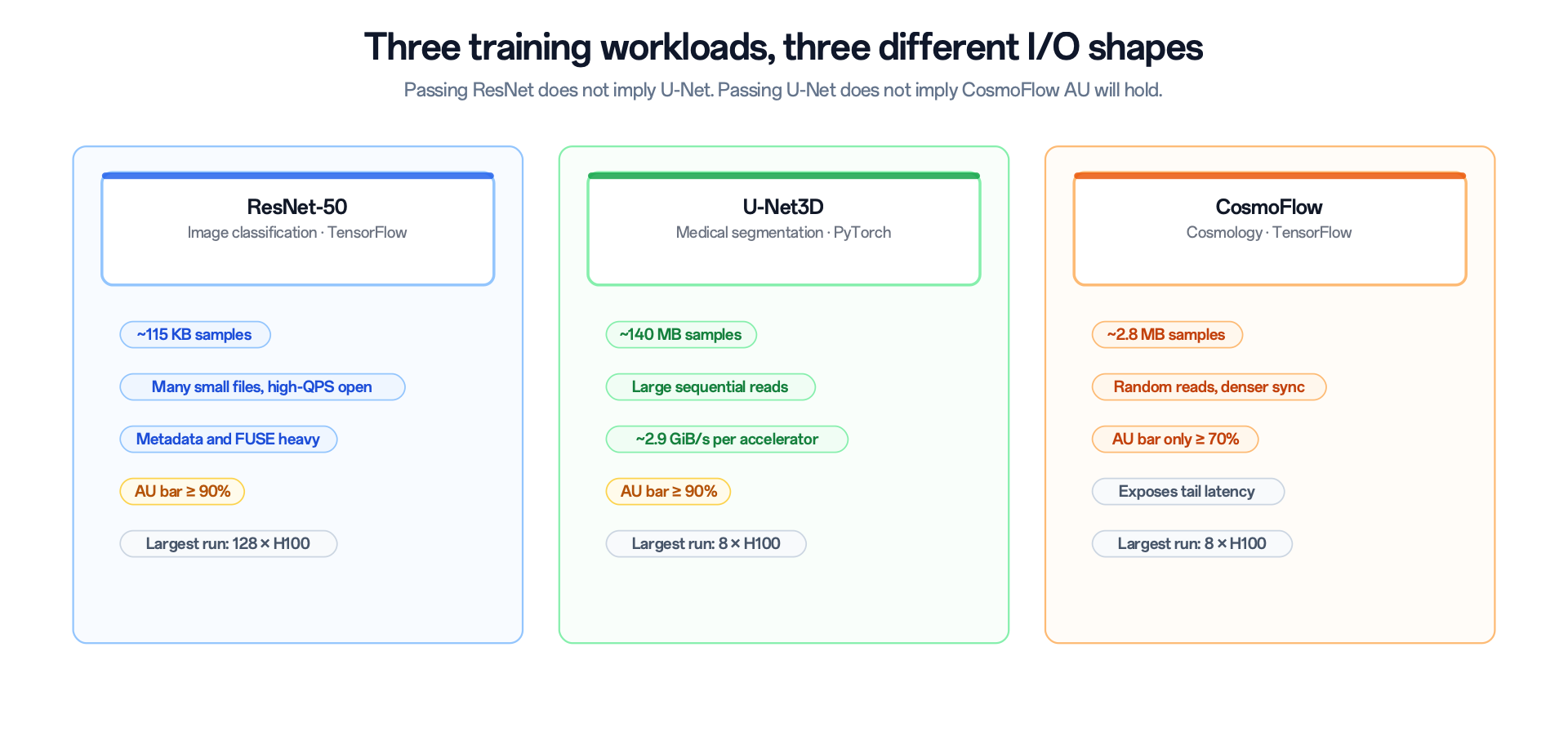
Figure 3: Small-file concurrency, large sequential reads, and medium-file random reads each test a different capability.
The scorecard
AU first.
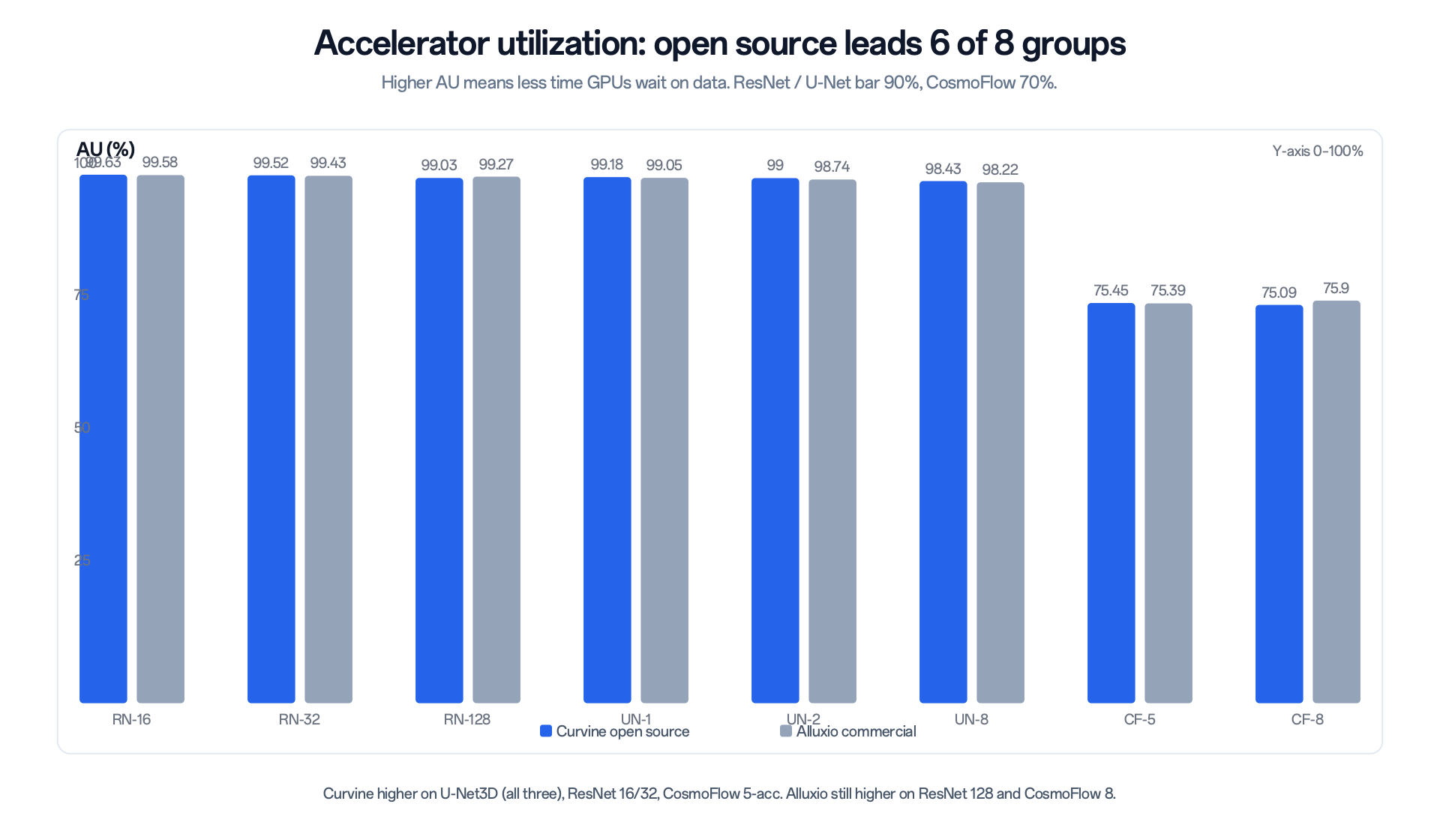
Figure 4: Open source leads 6 of 8. The losses are ResNet 128-acc and CosmoFlow 8-acc.
Then aggregate read bandwidth.
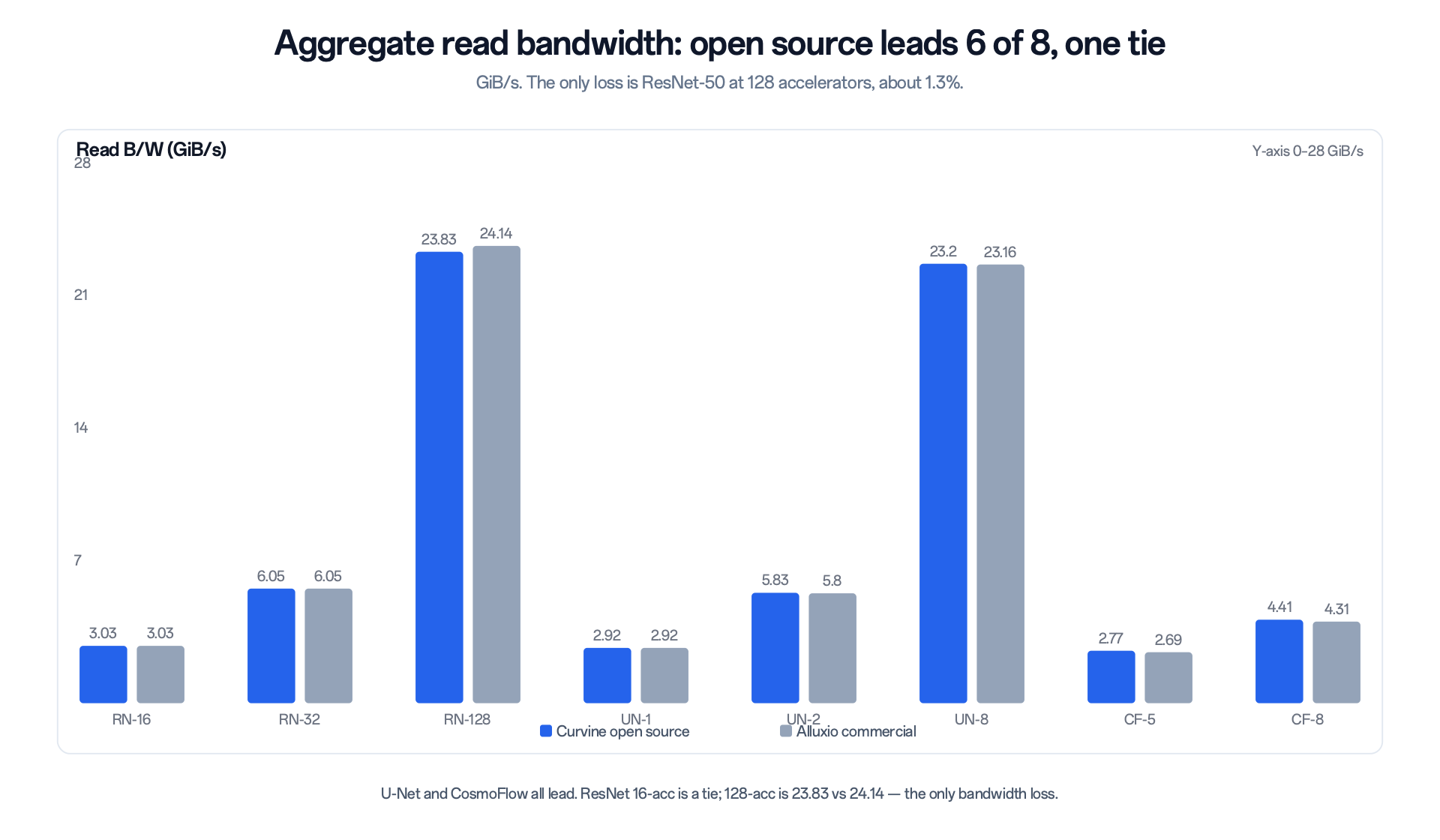
Figure 5: Open source leads 6 of 8, with one tie. The only loss is ResNet-50 at 128 accelerators, about 1.3%.
Full tables below. Alluxio numbers are the per-scale detail from the official submission. Their public materials often flatten AU into one headline per model (for example ResNet as 99.57%). Those headlines are rounded; this article uses the per-scale values. Some Curvine raw fields were labeled GB/s. The absolute values line up with Alluxio's GiB/s, so we report GiB/s throughout, which is the MLPerf convention.
ResNet-50 (AU bar 90%)
| Scale | Dataset | Fuse / Worker | Curvine AU | Alluxio AU | Curvine B/W | Alluxio B/W | Per acc (OSS / commercial) |
|---|---|---|---|---|---|---|---|
| 16 × H100 | 500 GB | 1 / 2 | 99.63% | 99.58% | 3.03 | 3.03 | 0.1894 / 0.1894 |
| 32 × H100 | 1.0 TB | 2 / 2 | 99.52% | 99.43% | 6.05 | 6.05 | 0.1892 / 0.1891 |
| 128 × H100 | 4.0 TB | 8 / 8 | 99.03% | 99.27% | 23.83 | 24.14 | 0.1861 / 0.1886 |
U-Net3D (AU bar 90%)
| Scale | Dataset | Fuse / Worker | Curvine AU | Alluxio AU | Curvine B/W | Alluxio B/W | Per acc (OSS / commercial) |
|---|---|---|---|---|---|---|---|
| 1 × H100 | 500 GB | 1 / 2 | 99.18% | 99.05% | 2.92 | 2.92 | 2.925 / 2.923 |
| 2 × H100 | 1.0 TB | 2 / 2 | 99.00% | 98.74% | 5.83 | 5.80 | 2.917 / 2.895 |
| 8 × H100 | 4.0 TB | 8 / 8 | 98.43% | 98.22% | 23.20 | 23.16 | 2.900 / 2.895 |
CosmoFlow (AU bar 70%)
| Scale | Dataset | Fuse / Worker | Curvine AU | Alluxio AU | Curvine B/W | Alluxio B/W | Per acc (OSS / commercial) |
|---|---|---|---|---|---|---|---|
| 5 × H100 | 500 GB | 1 / 2 | 75.45% | 75.39% | 2.77 | 2.69 | 0.554 / 0.539 |
| 8 × H100 | 1.0 TB | 2 / 8 vs 8 / 8 | 75.09% | 75.90% | 4.41 | 4.31 | 0.551 / 0.539 |
Across the eight groups: open source is higher on most points. Commercial Alluxio is still slightly better on ResNet 128-acc bandwidth and on two AU rows. This is not a sweep. It is also no longer "open source trailing commercial."
How to read the numbers
U-Net3D: ahead on all three lines
U-Net3D is a large sequential-read exam. One accelerator wants about 2.9 GiB/s; eight aggregate to about 23 GiB/s. AU, bandwidth, and per-accelerator bandwidth are all higher on Curvine. At 8 accelerators: AU 98.43% vs 98.22%, bandwidth 23.20 vs 23.16.
That matches the implementation. Rust, user-space FUSE, sequential reads on NVMe — this path likes large blocks. Medical images, checkpoints, and long-sequence features look more like this exam. Open source does not have to flinch here.
ResNet-50: ahead at 16 / 32 acc, 1.3% behind at 128
ResNet is a small-file exam. Samples are a little over 100 KB, opens are dense, and FUSE plus metadata get amplified.
At 16 and 32 accelerators, open-source AU is higher (99.63% / 99.52%) and bandwidth is tied or slightly ahead. At 128 accelerators with 8 FUSE + 8 Workers, bandwidth is 23.83 vs 24.14, about 1.3%; AU is 99.03% vs 99.27%, commercial slightly higher. Both are well above the 90% bar.
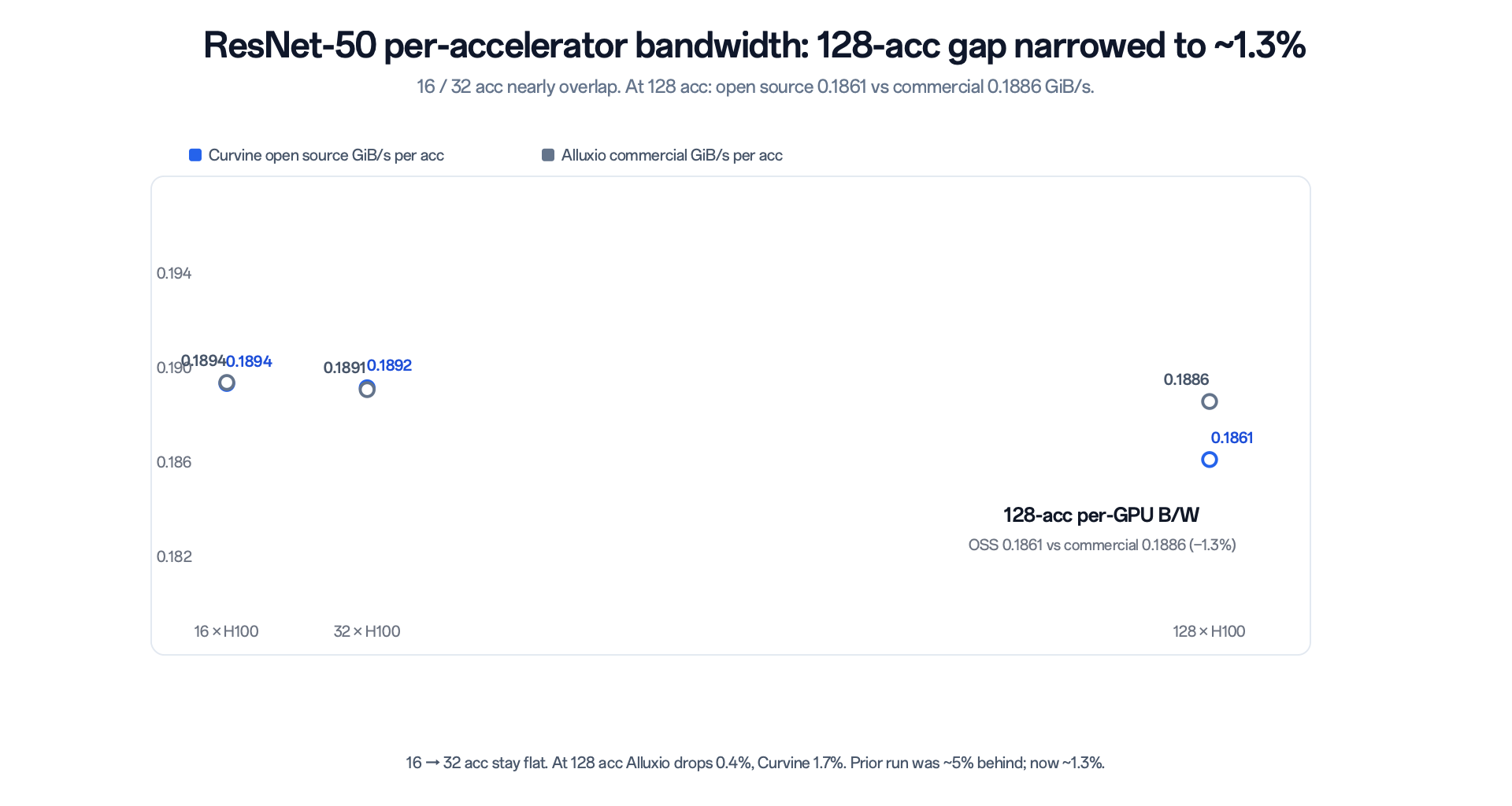
Figure 6: 16 → 32 acc almost overlap. At 128 acc, open source is 0.1861 per GPU, commercial 0.1886, about 1.3% apart.
From 16 to 128 accelerators, Alluxio's per-accelerator bandwidth drops 0.4%; Curvine drops 1.7%. In the previous comparison this gap was about 5%. This round it is 1.3%. On small-file, high-concurrency scale-out, the commercial stack is still a bit flatter. Open source has moved from "a visible drop" to "a point and a bit."
CosmoFlow: both bandwidth rows ahead, 5-acc AU also ahead
CosmoFlow's bar is only 70%, but tail latency shows up easily. At 5 accelerators: AU 75.45% vs 75.39%, bandwidth 2.77 vs 2.69 — open source higher on both. At 8 accelerators: bandwidth 4.41 vs 4.31, still open source; AU 75.09% vs 75.90%, commercial higher by less than one point.
Both pass 70%. The 8-accelerator client mix is not the same, so the bandwidth lead should not be read as a full win on that row. What we can say: on random reads, open source already feeds GPUs past the bar, and at 5 accelerators it also puts AU in front of the commercial number.
Closing
MLPerf compresses "is storage fast" into two questions: are the GPUs waiting, and does per-accelerator bandwidth fall as you scale. Commercial Alluxio used a Closed submission to show a DistCache can keep 128 emulated H100s above 99% AU. Open-source Curvine measured itself with the same ruler. It is ahead on most points, and a point-and-a-bit behind on a few.
The numbers are above. For an open-source project, putting the scorecard on the table is more useful than another "we lead everywhere" line.
Curvine repository: https://github.com/CurvineIO/curvine
Notes and sources
- Curvine: internal comparison, method aligned to MLPerf Storage v2.0, hardware aligned to Alluxio's official AWS topology. Not an official MLCommons Closed or Open submission.
- Alluxio: Enterprise AI, MLCommons
storage_results_v2.0Closed division. Per-scale bandwidth matches the Alluxio MLPerf documentation. Public materials often flatten ResNet AU to 99.57%, U-Net to 99.02%, CosmoFlow to 74.97%. This article uses the per-scale values. - Units: bandwidth is reported as GiB/s.
- CosmoFlow 8-accelerator client counts are not identical on both sides.
- MLPerf® is a trademark of MLCommons Association. This article does not imply MLCommons endorsement of any product.